 Cowswap
 fees affect the amount you receive after a trade.
Last updated -Cowswap fees combine execution costs and protocol charges within the amounts exchanged in a trade. Your total cost also depends on token approval, native-token handling, and any bridge or integration involved. For a fixed sell amount, compare the expected output after fees alongside the minimum acceptable receipt. For a fixed buy amount, compare the required input and maximum spend. Separately paid wallet transactions belong in the calculation, while slippage tolerance isn’t an automatic charge.
Bottom line: Compare the tokens you receive after trading costs, then account separately for any approval, wrapping, or other wallet transactions.
Approval Status and Token Form
Your existing token allowance and the form of your sell token determine whether preparation adds a separate network transaction. An ERC-20 trade needs spending authorization, but an adequate existing allowance can remove the need for another approval. Supported gasless approvals offer another path, subject to token and wallet compatibility. An ordinary approval transaction consumes gas independently of the later trade. Its wallet estimate therefore belongs beside the swap quote when comparing the cost of starting from your actual balance.
A native token introduces different preparation costs. Wrapping it first requires a network transaction; subsequent trades use the wrapped balance. Eth-flow combines wrapping and order placement in one transaction. In CoW Swap, this option supports swaps and excludes smart contract wallets. Compare the operations your balance still requires, without adding a hypothetical wrapping charge to tokens that you already hold wrapped. Repeated trades and a single trade can have different preparation costs.
Trading Options and Their Cost Conditions
Order types change the amount you constrain and the conditions that execution must satisfy. The following options also differ in their preparation or delivery requirements. A lower estimated cost doesn’t make them interchangeable when the intended receipt or timing differs.
| Trading Option | Amount to Compare | Execution Limits and Costs | Required Starting Conditions |
|---|---|---|---|
| Fixed-input swap | Output after fees | The trade must respect its minimum output | Sell balance and spending authorization |
| Fixed-output swap | Input required for the selected output | The trade must respect its maximum input | Sufficient sell balance and spending authorization |
| Limit order | Execution price after applicable costs | Available execution must cover costs within the limit | Funded, authorized order within its validity period |
| TWAP order | Aggregate amounts across executed parts | Each executed part incurs execution costs | Supported Safe wallet configuration and eligible part sizes |
| Cross-chain swap | Destination receipt after swap and bridge costs | The bridge provider charges for delivery | Supported source token and destination combination |
TWAP orders divide trading over time, while cross-chain swaps add delivery on another network.
Network Costs and Solver Payment
Settlement costs reimburse the work that solvers perform to execute orders on-chain. Solvers assemble transactions using available liquidity and submit the settlement. Gas prices, transaction complexity, and the liquidity needed for execution affect that cost. Batching and matching compatible orders can reduce the work required, although neither guarantees a particular saving. For limit orders, solver fee calculations must reflect execution costs rather than an arbitrary surcharge.
CoW Protocol expresses quoted network costs in the sell token. Paying through traded tokens changes how the expense reaches you; it doesn’t eliminate the expense.
Protocol Charges and Integration Fees
Protocol fees fund CoW Protocol and follow policies that distinguish volume, quote improvement, and surplus. A volume fee relates to trade size and asset classification. A quote-improvement fee relates to execution better than the quote. For an out-of-market limit order, the surplus policy instead uses the order’s limit as its reference.
These policies have different calculation bases. An improvement-based percentage doesn’t apply to the entire trade simply because it appears in a fee description. Governance can change rates, caps, and policy application, so a remembered percentage doesn’t establish the cost of another order.
Protocol charges reduce output for sell orders or increase input for buy orders relative to execution without those charges. Integrations can also configure partner fees, which compensate the integrating partner subject to the protocol’s service share. Such a charge depends on the integration; it isn’t a universal extra charge for every interface.
Is Slippage Tolerance a Trading Fee?
Slippage tolerance is an execution boundary, so it doesn’t automatically deduct its full percentage from your trade. The expected output describes the quoted outcome. The minimum output allows a specified amount of adverse movement before execution becomes unacceptable. Comparing one quote’s expected receipt with another quote’s minimum receipt mixes two different measures. Keep both figures, and compare each with its counterpart. A wider tolerance changes the outcome you permit; it doesn’t establish a lower protocol charge.
Price impact describes how trading against available liquidity changes the execution price. Pool charges can also affect a route’s exchange rate. Those effects already influence the output that a route offers, so subtracting them again from a net quote would double-count them. A difference from a market reference price can include these effects and market movement. Calling that entire difference a platform fee obscures what caused it.
Limit Prices and Partial Fills
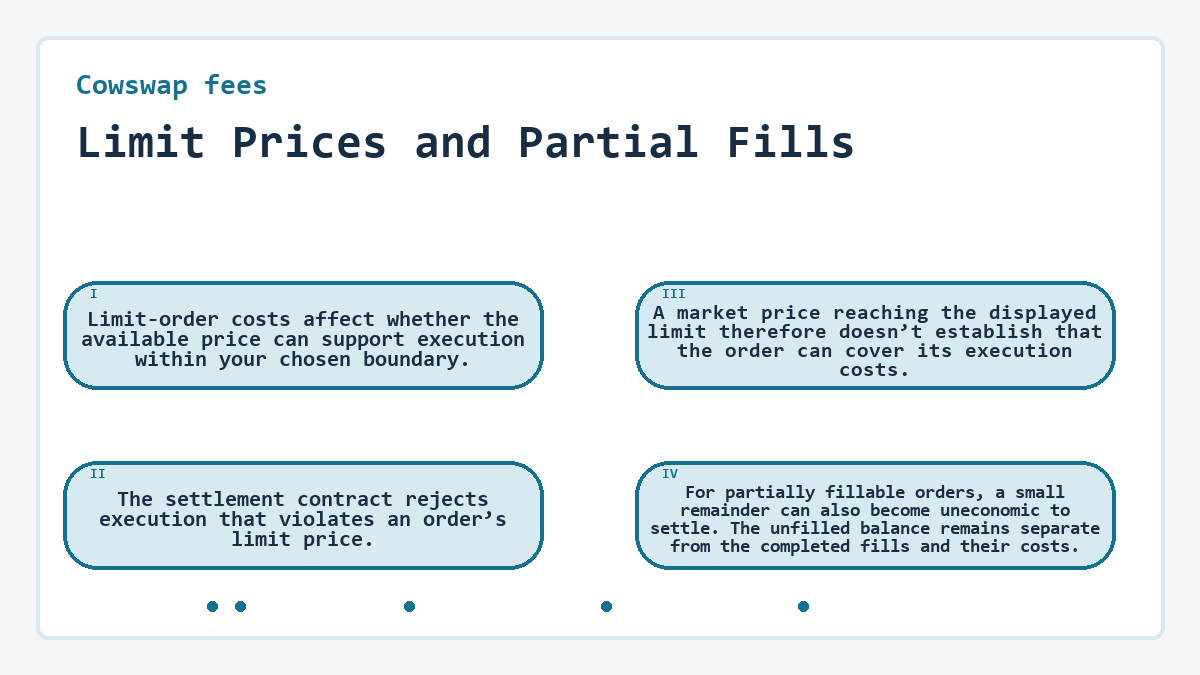
Limit-order costs affect whether the available price can support execution within your chosen boundary. The settlement contract rejects execution that violates an order’s limit price. A market price reaching the displayed limit therefore doesn’t establish that the order can cover its execution costs. For partially fillable orders, a small remainder can also become uneconomic to settle. The unfilled balance remains separate from the completed fills and their costs.
How Should You Compare Quotes After Fees?
A reproducible comparison holds the token pair, network, amount, and order direction constant while comparing net quoted amounts. Collect the quotes close together because liquidity and gas conditions change. Also record any difference in the recipient’s destination network or token contract. An amount arriving somewhere else doesn’t satisfy the same task, even when its symbol looks familiar.
For a fixed input, the net exchange rate equals expected output divided by total trade input. That relationship compares execution without requiring a guessed market price. Separately paid gas remains an additional expense. To combine it with the output, convert that expense into the output token using one consistent valuation point. Keep the original gas quantity in the record so that exchange-rate movement doesn’t masquerade as a different network charge.
For a fixed output, compare total required input plus separately paid costs on a common valuation basis. Don’t subtract a fee twice when the displayed amount already includes it. A cross-chain comparison must use the destination amount after bridge charges, rather than the intermediate amount deposited with the bridge provider. The quote distinguishes those amounts because they represent different stages of delivery.
Quoted Costs and Executed Amounts
A completed trade’s executed input and output establish its realized exchange rate. The earlier quote remains useful for measuring the difference between expectation and settlement. Record the order-specific amounts rather than treating the entire settlement transaction as your trade: a batch can contain other orders. Likewise, the transaction’s total gas bill doesn’t establish the network cost allocated to your individual order.
Fee accounting also needs the policies attached to the execution and, where applicable, the quote used as the improvement reference. A simple difference between two token amounts can’t isolate every fee component. Executions of one order in different auctions can carry different active fee policies.
An unfilled balance has no realized exchange rate. Keep its potential future cost separate from the costs of completed fills.
Your questions, answered
Can a Failed native-token Swap Still Cost Gas?
A native-token order can incur an upfront transaction fee even if the later swap doesn’t execute. The native-token submission flow wraps funds and places the order through an on-chain transaction. Refunding the trading funds doesn’t refund the gas already consumed by that transaction. This differs from merely signing an off-chain token order.
Does Splitting a Trade Into TWAP Parts Always Reduce Its Total Cost?
Splitting a trade can reduce price impact while adding execution costs across its parts. Whether the combined outcome improves depends on liquidity, market movement, and the cost of executing each part. Compare aggregate input and output across completed parts, alongside any setup transaction, rather than judging the schedule by one fill.
Why Does a Signed Order Show a Zero Fee When the Trade Has Costs?
A zero signed fee field doesn’t mean that execution is free. CoW Protocol can incorporate charges into the exchanged amounts rather than using that field as the total bill. The quote’s network-cost field and the completed order’s fee records describe different information. Inspect executed amounts and the associated fee breakdown when reconciling a completed trade.
Will a Bridge Refund Reverse the Cost of an Already Completed Swap?
A bridge refund doesn’t by itself reverse the preceding swap. Bridging begins after swap execution, and a failed bridge transfer follows the provider’s refund policy. The returned asset can therefore be the intermediate asset produced by that swap. Keep the completed swap’s costs separate from the bridge refund and any subsequent recovery transaction. If the provider returns funds to your Account Proxy, wait until the refund appears there, then recover the returned token to your wallet through CoW Swap’s Account Proxy page.
Do Financing Charges Belong in an Ordinary Swap Cost Comparison?
An ordinary swap funded with tokens already in your wallet doesn’t itself require borrowing. Financing charges belong in the calculation when a separate borrowing or flash-loan operation forms part of the transaction. Any interest or loan fee charged by the lender adds to the cost; repayment of the borrowed principal isn’t itself a fee. These financing charges aren’t universal Cowswap fees.